Rising damp & salt attack · South East QLD
Nine questions. Then the cause has a name.
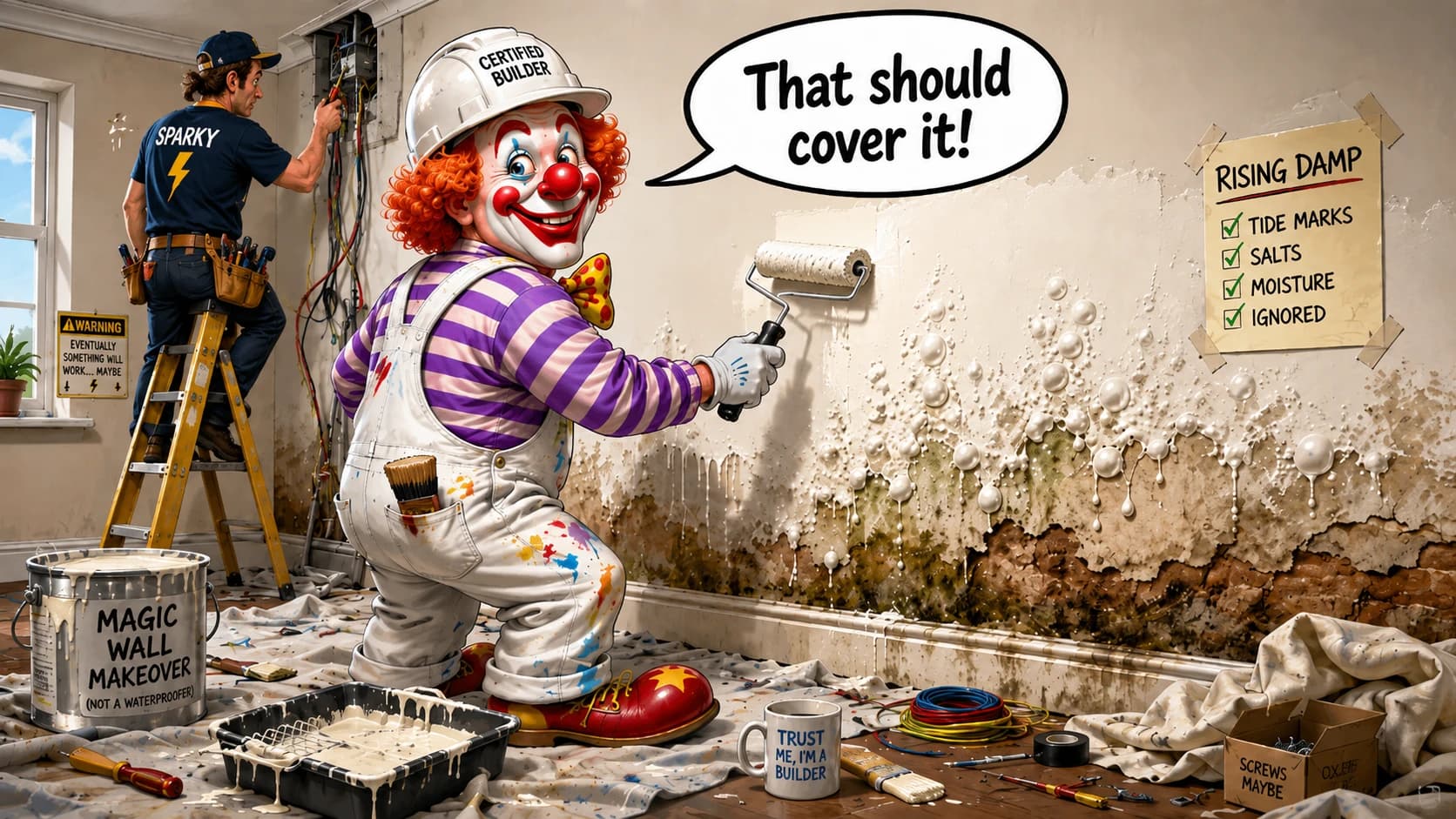
another coat of paint definitely won't do it
Salt bloom, chalky brick, mortar turning to sand, a damp line creeping up the wall. This site sets out what actually causes each of them — and nine times out of ten the answer is cheaper than a damp course.
What are you looking at?
Start with what you can see. Every one of these gets blamed on rising damp, and only some of them are.
- White salt on the bricksA powdery bloom, worse after rainHave a look
- Bricks going chalkyMortar turning to sand, faces flaking offHave a look
- A tide mark on the wallA level damp line, low downHave a look
- Paint bubbling, render blowingBlistering near the floor or the groundHave a look
- A damp concrete slabWet patches under vinyl, cupping timberHave a look
- Damp under the houseMusty subfloor, damp smell insideHave a look
The bit nobody selling the cure will tell you
Rising damp is real. It's just not what most people have.
Condensation, a blocked downpipe, a garden bed built up over the damp course, a sprinkler pointed at the wall, an air-conditioner draining into the footing, moisture through a slab. All of these look like rising damp. None of them are fixed by a damp course.
The awkward part is that in this trade the person diagnosing the problem is usually the person selling the cure, and they turn up holding a two-pin moisture meter that reads absurdly high on any wall with salt in it — wet or bone dry. This site sells nothing, which is why it can afford to say so.
Why this site argues against the saleWhat a damp course actually is
Two remedial methods cover most genuine cases.
- Chemical damp course
- External brickwork — A new damp-proof course injected into the mortar bed, to stop groundwater climbing the wall.
- Negative-side slab membrane
- Internal concrete slabs — An epoxy moisture barrier applied to the top of the slab — grind back, prepare the surface, then apply the membrane before the new floor goes down.
Render replacement, saw-cut damp courses, drainage, landscaping and subfloor ventilation are all sometimes the right answer instead, and each is a different trade.
The line-up
Nine questions. Then it names the suspect.
It returns a named cause, what is actually happening in plain English, the cheapest thing to try first, roughly what that costs in Australia, and a straight yes or no on whether a specialist is needed at all. No email address, no phone number, no sales call.
Of the 12 causes it can identify, 9 need no damp specialist at all.
Run the line-up- Independent
- No building licence, no building work, nothing for sale. The reasoning is published so it can be checked against whatever anyone tells you
- Common here, not exotic
- Shallow salty water tables and built-up garden beds make this a Gold Coast speciality — which is also why it gets over-diagnosed
- Costs, as research
- Published Australian rates for damp-course injection and the cheaper fixes that are not a damp course, so a quote can be read against something
- Where the work goes
- To a licensed waterproofer engaged directly. This site does not quote, attend, warrant or arrange anything
When a wall does need work.
Damp that has been traced to a genuine cause and needs a licensed trade is where this site stops. Submit your details and they'll be passed to a licensed waterproofing contractor who can assess the issue. Photographs help — the whole wall from a distance, a close-up of the damp and any salt, and the ground outside at the base of that wall.
Salty Slabs is an independent reference on rising damp, salt damp and efflorescence. It publishes research and a diagnostic tool. It holds no building licence, carries out no building work, and sells nothing.